

All-on-4 dental implants replace an entire upper or lower arch of teeth with a fixed bridge that is anchored to just four dental implants. The back implants are tilted at an angle to make use of the bone you already have, which often means no bone graft is needed. It is a strong option for people who are missing most or all of their teeth, or whose remaining teeth are failing, and who want fixed teeth instead of removable dentures.
How Do All-on-4 Implants Work?
The name describes the design: four implants per arch, and a full set of teeth that attaches to all four of them. Two implants sit upright toward the front of the jaw, where bone is naturally thickest, and two are placed farther back at a precise angle. Tilting the back implants lets your prosthodontist anchor them in existing bone instead of placing them where bone has worn away, which is why the approach can often skip a bone graft.
Once the implants are in place, a custom bridge is secured to them. You are not removing it at night and there are no adhesives — it is cleaned like natural teeth, and it is shaped for your bite, your speech, and your smile line.
What Is the All-on-4 Process, Step by Step?
- Consultation and imaging. You meet a prosthodontist, review your goals and dental history, and take 3D scans and digital X-rays so we can see exactly how much bone you have and where the nerves run.
- Treatment planning. We map the position and angle of all four implants before anything is placed, usually with a surgical guide, and confirm the plan with you along with clear pricing.
- Implant placement. The four implants are placed in one appointment. Most patients go home the same day.
- Healing. Over the following months the implants bond with your jawbone. A temporary set of teeth lets you eat, speak, and smile normally while your final bridge is made.
- Final bridge. Your permanent, custom bridge is attached and your bite is fine-tuned. Because our dental laboratory is in-house, your restoration is fabricated by our own team.
- Follow-up care. You come back for checkups so we can confirm the implants are healthy and your bite is still even.
Who Is a Good Candidate for All-on-4?
Most people who are missing an entire arch, or whose teeth are too damaged to save, can be evaluated for All-on-4. Good candidates usually:
- Are missing most or all teeth in one arch, or have teeth that are loose, badly decayed, or failing under old work.
- Are tired of removable dentures that slip, need adhesives, or make eating certain foods a guess.
- Have enough healthy jawbone for the four implants — often including patients who were told they would need a bone graft, because the tilted back implants can use the bone that is already there.
- Are in generally good health and healing well. Conditions such as uncontrolled diabetes, heavy smoking, or recent radiation to the jaw can affect healing and may need to be managed first.
- Can commit to daily cleaning and regular checkups, which is what keeps implants healthy for the long term.
The only way to know for sure is a consultation with 3D imaging. Some patients need a small amount of grafting, a different number of implants, or a different option entirely — and a good practice will tell you that honestly instead of selling one treatment to everyone.
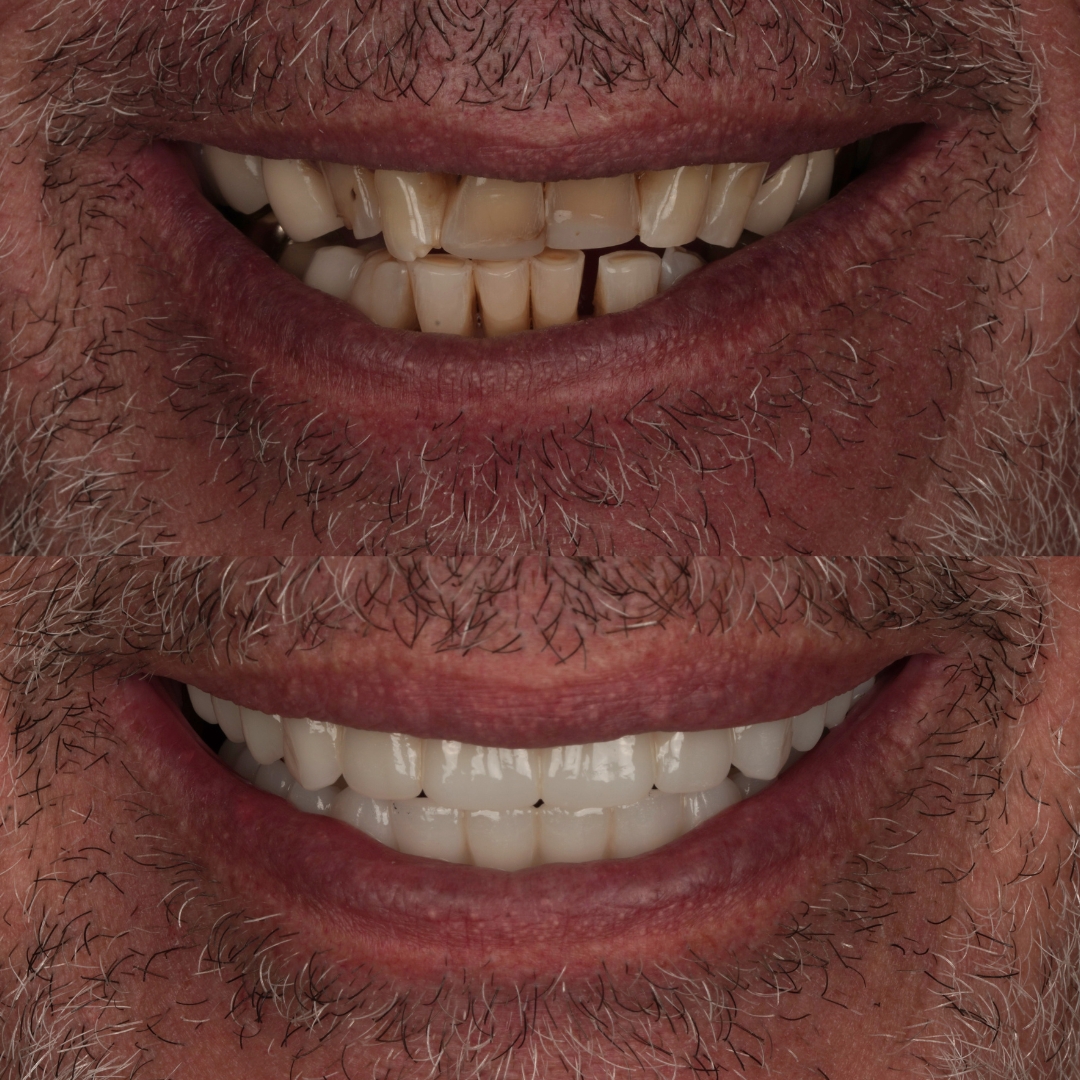
Actual patient result at Restorative Dentistry Group. Individual results vary.
All-on-4 vs. Traditional Implants vs. Dentures
| All-on-4 | Traditional Implants | Dentures | |
|---|---|---|---|
| Best for | A full arch of missing or failing teeth | One tooth up to several teeth in a row | Many or all teeth |
| Number of implants per arch | Four | One per tooth, or more for a full arch | None (or two for snap-on) |
| Fixed or removable | Fixed | Fixed | Removable |
| Usually needs bone grafting | Often not | Frequently, for a full arch | No |
| Stays in place while eating | Yes | Yes | Can slip |
| Protects jawbone | Yes | Yes | No; bone loss can loosen the fit |
| Upfront cost | Mid to high | Highest for a full arch | Lowest |
How Long Does All-on-4 Take?
The implants themselves are placed in a single appointment. Most patients finish treatment in roughly three to six months, depending on how quickly the implants bond with the bone and whether any preparatory work is needed. Your final bridge is custom-made for you, and our in-house dental laboratory means we control that process instead of waiting on an outside shop.
What Are the Risks and Limitations?
All-on-4 is a surgical procedure, so it carries the usual surgical considerations: swelling and soreness for a few days, and a small risk of infection or implant trouble, which is why follow-up visits matter. It also requires healthy gums and a commitment to cleaning under and around the bridge every day. And it is not the right answer for everyone — if the bone in your jaw cannot support four implants, your prosthodontist should say so and discuss alternatives rather than force the case.
Why Have All-on-4 Done by a Prosthodontist?
Full-arch replacement is exactly what prosthodontists train for: three or more additional years of specialty education beyond dental school, focused on restoring and replacing teeth. In an All-on-4 case, that means the doctor planning your implant angles, your bite, and your final teeth is the same specialist who placed them. At Restorative Dentistry Group, every center has a prosthodontist, and our in-house laboratory crafts the restorations. Not sure what a prosthodontist is? Read our guide.
All-on-4 implant-supported dentures → · Dental implants → · Full-mouth rehabilitation →
Frequently Asked Questions
How many teeth does All-on-4 replace?
All-on-4 replaces a complete upper or lower arch — typically 10 to 14 teeth in one custom bridge — using four implants. Each arch is treated separately, so some patients have both an upper and a lower arch done.
Am I a candidate for All-on-4?
Most people missing most or all of their teeth in an arch can be evaluated. The deciding factor is whether you have enough healthy jawbone to support four implants, which we check with 3D imaging at your consultation. Because the back implants are tilted, many patients who were told they needed a bone graft still qualify.
Does All-on-4 require a bone graft?
Often not. The tilted back implants are placed to use the bone you already have, which is the main advantage of the design. Some cases do still need grafting, and your prosthodontist will tell you which group you are in after reviewing your scans.
How long do All-on-4 implants last?
The implants themselves can last for decades with good daily cleaning and regular checkups. The bridge on top is the part that wears over time and may need to be replaced or refreshed after a number of years.
Is All-on-4 painful?
The placement is done with anesthesia, so you should not feel pain during the procedure. Most patients report soreness and swelling for a few days afterward, managed with medication and cold compresses, and return to normal routines within about a week.
Can I get All-on-4 if I already wear dentures?
Yes. Many All-on-4 patients are current denture wearers who want a fixed solution. Your existing dentures can often be used as the temporary teeth while your final bridge is made.
What does All-on-4 cost?
It varies with the arches treated, the materials in your bridge, and any preparatory work. Our team reviews your insurance benefits and financing options with you before treatment so the number is clear up front.
Do I need a referral?
No. You can request a consultation directly at any of our six Colorado centers. If you already have a general dentist, we are glad to coordinate your care with them.